

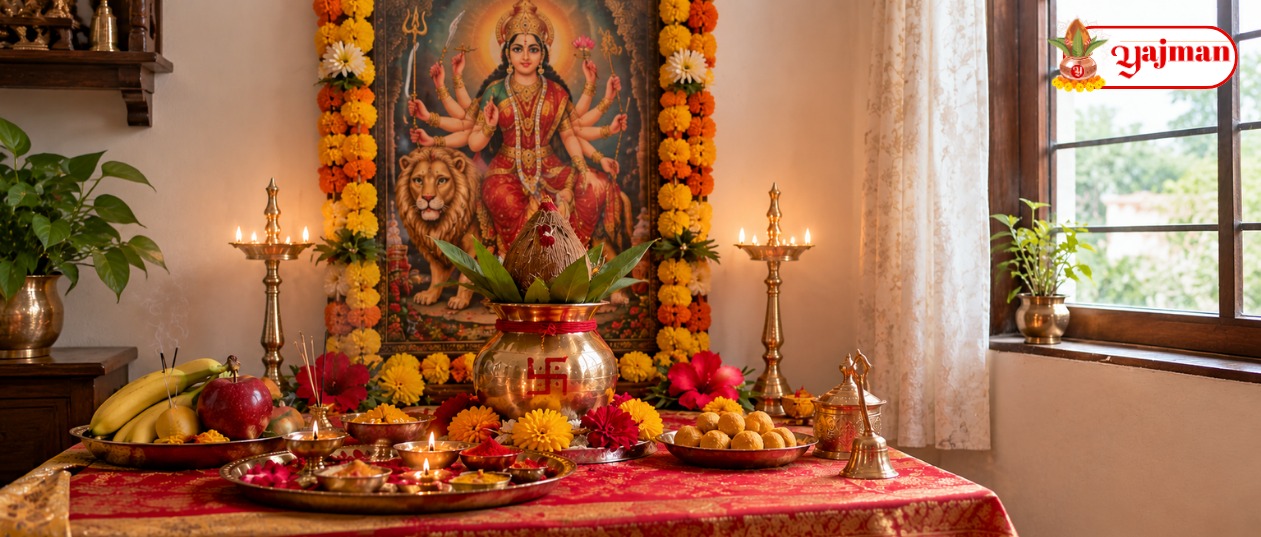
What Makes Maha Navmi So Special in Navratri?
After eight days of fasting, prayer and devotion, the ninth day of Navratri arrives with a calm and powerful energy. Homes smell of ghee and incense, little girls in red scarves are welcomed like living goddesses, and families sit together around the sacred fire. This is Maha Navmi, the day when the Navratri journey reaches its spiritual peak.
Many devotees ask a simple question every year: what is the importance of Maha Navmi, and why is it called the most powerful day of Sharad Navratri? This guide answers that in plain language. You will learn the meaning of Maha Navmi, the Maha Navmi 2026 date and shubh muhurat, the story behind the festival, the significance of Goddess Siddhidatri, the correct puja vidhi, kanya pujan rules, hawan benefits and common mistakes to avoid. At the end, you will also see how Yajman App can help you perform the puja properly, even if you live far from family or do not have a pandit nearby.
What Is Maha Navmi?
Maha Navmi, also written as Maha Navami or Mahanavami, is the ninth and final day of the nine nights of Navratri, observed on the Navami tithi of the Shukla Paksha in the month of Ashwin. The word Maha means great and Navmi means the ninth lunar day, so the name itself tells us this day carries special weight.
In simple words, Maha Navmi is the day of completion. The first eight days prepare the devotee through discipline, fasting and prayer. The ninth day brings the fulfilment of that effort. This is why it is believed that worship done on Maha Navmi brings the full fruit of the entire Navratri observance.
Maha Navmi 2026 Date and Shubh Muhurat
In 2026, Maha Navmi falls on Monday, October 19. According to the Ujjain panchang as published by Haindavam, the Navami tithi begins around 10:52 AM on October 19 and continues until about 12:50 PM on October 20. The Aparahna muhurat, which is the afternoon window many families prefer for puja and hawan, runs from about 1:20 PM to 3:38 PM on October 19.
Tithi timings change slightly from city to city, and families follow different traditions about whether to perform kanya pujan in the morning or afternoon. Please confirm the exact timing for your location with your family pandit or through Yajman App before finalising your puja. Vijayadashami follows right after Navami, so many devotees plan the closing rituals of Navratri carefully around both days.
Why Is Maha Navmi Celebrated? The Story Behind the Day
The most widely told reason is the victory of Goddess Durga over the buffalo demon Mahishasur. This story is narrated in the Devi Mahatmya, also known as Durga Saptashati or Chandi Path, which forms part of the Markandeya Purana. According to the text, the gods were defeated by Mahishasura and approached Brahma, Vishnu and Shiva. Their combined energy took the form of Goddess Durga, who was armed by every deity with their own weapons. In the same text, the Goddess also destroys the demons Chanda and Munda, whose slaying earns her the name Chamunda.
Popular tradition holds that the Goddess fought Mahishasura over nine nights and that the final decisive day is Navami. Regional traditions differ slightly on the exact day of his fall, but the central message is the same across India: righteousness defeats arrogance and evil.
There is also a second tradition connected to Lord Rama. The Devi Bhagavata Purana, in its third book, describes how Rama worshipped the Goddess during Navratri before his battle with Ravana. Bengali devotional literature, especially the Krittivasi Ramayana, narrates the story of Akal Bodhan, the untimely awakening of the Goddess by Rama. This is why Navami and Dashami are so closely linked to victory and success in many households.
Goddess Siddhidatri: The Deity of Maha Navmi
On the ninth day, devotees worship Goddess Siddhidatri, the ninth form of the Navadurga. The nine forms are listed in the Devi Kavacha, a hymn recited along with the Durga Saptashati, which names Shailaputri, Brahmacharini, Chandraghanta, Kushmanda, Skandamata, Katyayani, Kalaratri, Mahagauri and Siddhidatri.
The name Siddhidatri means the giver of siddhis, or spiritual accomplishments. Classical yogic and Puranic literature speaks of eight siddhis, including Anima, Mahima, Garima, Laghima, Prapti, Prakamya, Ishitva and Vashitva. According to the Devi Purana tradition, Lord Shiva himself gained these powers through her grace, and it is said that his form as Ardhanarishvara, half male and half female, arose from this blessing.
Iconography shows the Goddess seated on a lotus, sometimes riding a lion, with four arms holding a chakra, a conch, a mace and a lotus. Her calm face symbolises that true power is gentle, balanced and free of ego. A commonly recited devotional line to her is Om Devi Siddhidatryai Namah. A well known hymn from the Devi Mahatmya, chapter five, also expresses the spirit of the day: Ya Devi sarvabhuteshu shakti rupena samsthita, namastasyai namastasyai namastasyai namo namah. It means that salutations are offered again and again to the Goddess who dwells in all beings in the form of power.
Spiritual and Astrological Importance of Maha Navmi
From a spiritual angle, Maha Navmi represents the ripening of effort. Devotees who fasted and prayed for eight days now offer gratitude and ask for strength, wisdom and protection. It is considered an ideal day to seek blessings for the family, health, career, education and peace of mind.
From an astrological angle, the Navami tithi of Navratri is believed to be powerful for removing obstacles and bringing stability. Many families choose this day for Durga Saptashati path, Navchandi hawan and special sankalp puja. Astrological opinions vary between traditions, so it is wise to consult a knowledgeable pandit for guidance specific to your family.
There is also a cultural importance. Maha Navmi brings relatives together, teaches children to respect women and girls, and keeps ancient rituals alive in a busy modern life.
Maha Navmi Puja Vidhi at Home
A simple and sincere puja is always better than a complicated one done without understanding. The following steps reflect the commonly followed home puja vidhi. Your family tradition or pandit may add or change certain details.
Wake up early, bathe and wear clean clothes. Many devotees prefer red or yellow.
Clean the puja space and the Kalash established on the first day of Navratri.
Light a diya and incense, and take a sankalp stating your name, gotra, place and the wish for which you are performing the puja.
Offer water, red flowers, roli, akshat, kumkum, fruits, coconut and sweets to the Goddess.
Chant the Siddhidatri mantra and recite the Durga Saptashati, Durga Chalisa or Devi Kavacha as per your practice.
Offer the traditional bhog of halwa, chana and puri, along with sesame seeds or other items as per your family custom.
Perform the aarti and distribute prasad.
Conduct kanya pujan and, if possible, a hawan, then conclude with the Navratri visarjan or closing rituals as advised.
Kanya Pujan on Maha Navmi
Kanya pujan is the emotional heart of Maha Navmi. Young girls, usually between the ages of two and ten, are worshipped as living forms of the Goddess. The Devi Bhagavata Purana describes the worship of Kumaris during Navratri and explains the merit associated with honouring young girls with devotion.
In most homes, nine girls and one boy, who represents Batuk Bhairav or Langur, are invited. Their feet are washed with clean water, a tilak is applied, and they are seated with respect. They are served halwa, black chana and puri, and then given small gifts, fruits or money, along with a request for blessings.
The most important point is the spirit of the ritual. The girls should be treated with warmth and dignity, and the food should be fresh and sattvic. Kanya pujan is not only a custom, it is a reminder that divinity lives in every girl and woman.
Maha Navmi Hawan and Its Benefits
Many families conclude Navratri with a Durga hawan on Navami. A hawan, also called a homa or yajna, is a sacred fire ritual in which offerings of ghee, herbs, grains and samagri are made to Agni while mantras are chanted. Agni is regarded in Vedic tradition as the divine messenger who carries offerings to the deities, a concept that appears in the opening hymn of the Rigveda.
Devotees believe that a Maha Navmi hawan purifies the home environment, brings mental calm and invites positivity. A Navchandi or Durga Saptashati hawan is especially popular, where verses of the Devi Mahatmya are chanted along with offerings. Because the mantras and the sequence of offerings must be accurate, a hawan is best performed under the guidance of a trained pandit.
No Vedic ritual of this scale is complete without the sacred flame. On Maha Navami, the household gathers around the Havan Kund to offer final oblations to Lord Agni, who acts as the divine intermediary between mortals and the gods.
During the Navami Havan, holy wood (Samidha) such as mango, dry coconut husks, guggul, pure desi cow ghee, black sesame seeds, and fragrant herbs are placed into the consecrated fire. With each verse recited from the Devi Saptashati (Chandi Path) or through sacred Navarna Mantras:
ॐ ऐं ह्रीं क्लीं चामुण्डायै विच्चे ॥
Om Aim Hreem Kleem Chamundayai Vichche.
Devotees offer sacred ahutis into the flames, ending with the chanting of Svaha. The ritual reaches its spiritual zenith during the Purnahuti—the final offering of a dry coconut filled with ghee, wrapped in red cloth, and placed reverently into the center of the havan fire. The rising smoke purifies the home, balances atmospheric energies, and clears away accumulated spiritual heaviness.
Spiritual and Astrological Importance of Maha Navmi
From a spiritual angle, Maha Navmi represents the ripening of effort. Devotees who fasted and prayed for eight days now offer gratitude and ask for strength, wisdom and protection. It is considered an ideal day to seek blessings for the family, health, career, education and peace of mind.
From an astrological angle, the Navami tithi of Navratri is believed to be powerful for removing obstacles and bringing stability. Many families choose this day for Durga Saptashati path, Navchandi hawan and special sankalp puja. Astrological opinions vary between traditions, so it is wise to consult a knowledgeable pandit for guidance specific to your family.
There is also a cultural importance. Maha Navmi brings relatives together, teaches children to respect women and girls, and keeps ancient rituals alive in a busy modern life.
Regional Traditions of Maha Navmi Across India
The festival wears different colours in different regions, but the devotion remains the same.
In North and Central India, including Madhya Pradesh, Uttar Pradesh, Rajasthan and Himachal Pradesh, Maha Navmi is known for kanya pujan, fasting and hawan. Many families end the nine day vrat on this day.
In Bengal, the Sandhi Puja is performed at the junction of Ashtami and Navami. It is believed to mark the moment when the Goddess took the fierce form of Chamunda against Chanda and Munda, in line with the Devi Mahatmya.
In Karnataka, Maha Navmi is celebrated as Ayudha Puja, when tools, books, vehicles and instruments are cleaned and worshipped as symbols of divine energy. The royal Dasara festival of Mysuru is closely linked to the legacy of the Vijayanagara Empire, whose Mahanavami Dibba at Hampi still stands as historical evidence of the grand Navami celebrations of that era.
In Tamil Nadu, Andhra Pradesh and Kerala, the day is observed as Saraswati Puja and Ayudha Puja, with books and musical instruments placed before the deity.
Common Mistakes to Avoid on Maha Navmi
A few simple errors can reduce the peace of the day. Avoid starting the puja without a clear sankalp. Avoid rushing kanya pujan or inviting children without informing their parents in advance. Avoid using impure or stale food for bhog. Avoid performing a hawan without a safe space, proper samagri and correct mantras. Finally, avoid treating the day only as a ritual. Maha Navmi asks for humility, gratitude and kindness along with the offerings.
How Yajman App Helps You Perform Maha Navmi Puja Properly
Today many families live in different cities, have busy schedules, or simply do not know a reliable pandit nearby. This is exactly where Yajman App makes devotion easier.
Here is what Yajman App offers for your Maha Navmi puja:
Verified and experienced pandits who understand the vidhi, mantras and local traditions.
Easy online booking of Maha Navmi puja, Durga hawan, Durga Saptashati path and kanya pujan guidance from the comfort of your home.
Puja samagri assistance, so you do not have to run from shop to shop on a festival morning.
Muhurat guidance based on your location, so your puja is timed correctly.
Transparent pricing and a simple booking process with no confusion.
Support for both online and in person puja, depending on your need and city.
Whether you want a small family puja or a complete Navchandi hawan, you can explore services and book a pandit at https://yajmanapp.com/. Booking early is helpful, because pandits are in high demand around Navami and Dashami.
Maha Navmi is more than the ninth day on the calendar. It is the day when devotion turns into fulfilment, when the Goddess is thanked for her protection, and when families reconnect with their roots through puja, kanya pujan and hawan. Whether you follow the Devi Mahatmya, the Rama tradition, or your own family custom, the heart of the festival remains the same: truth, courage and gratitude.
This year, on October 19, 2026, let your Maha Navmi be prepared, peaceful and meaningful. If you would like a trusted pandit to guide your puja, Yajman App is ready to help you at every step.
Frequently Asked Questions About Maha Navmi
1. What is the importance of Maha Navmi?
Maha Navmi is the ninth and concluding day of Navratri, when Goddess Siddhidatri is worshipped. It is believed to bring the complete fruit of nine days of devotion and is associated with the victory of good over evil and the grant of spiritual strength.
2. When is Maha Navmi in 2026?
Maha Navmi 2026 is on Monday, October 19. As per the Ujjain panchang, the Navami tithi starts around 10:52 AM on October 19 and ends around 12:50 PM on October 20. Please confirm local timings with your pandit.
3. Which goddess is worshipped on Maha Navmi?
Goddess Siddhidatri, the ninth form of Navadurga, is worshipped. She is regarded as the giver of siddhis, wisdom and spiritual accomplishment, and is described as seated on a lotus with a calm and compassionate form.
4. Why is kanya pujan performed on Maha Navmi?
Kanya pujan honours young girls as living forms of the Goddess. The Devi Bhagavata Purana speaks of Kumari worship during Navratri. It is done on Ashtami or Navami to express gratitude and seek the blessings of the Divine Mother.
5. What is the correct puja vidhi for Maha Navmi at home?
Begin with a bath and sankalp, worship the Goddess with flowers, roli, akshat and bhog, chant her mantra, recite the Durga Saptashati or Chalisa, perform aarti, and complete with kanya pujan. A hawan may be added with the guidance of a pandit.
6. What should I offer as bhog on Maha Navmi?
Traditional bhog includes halwa, black chana and puri, along with fruits and sweets. Some families also offer sesame seeds or other items according to their custom. Always keep the food fresh, clean and sattvic.
7. Is hawan necessary on Maha Navmi?
Hawan is not mandatory, but many families perform it to conclude Navratri. It is considered auspicious and purifying. A simple puja with devotion is also complete, and you can choose according to your family tradition.
8. How can I book a pandit for Maha Navmi puja?
You can book a verified pandit for Maha Navmi puja, hawan or Durga Saptashati path through Yajman App. Select your puja, choose your date and city, and confirm your booking in a few simple steps.