

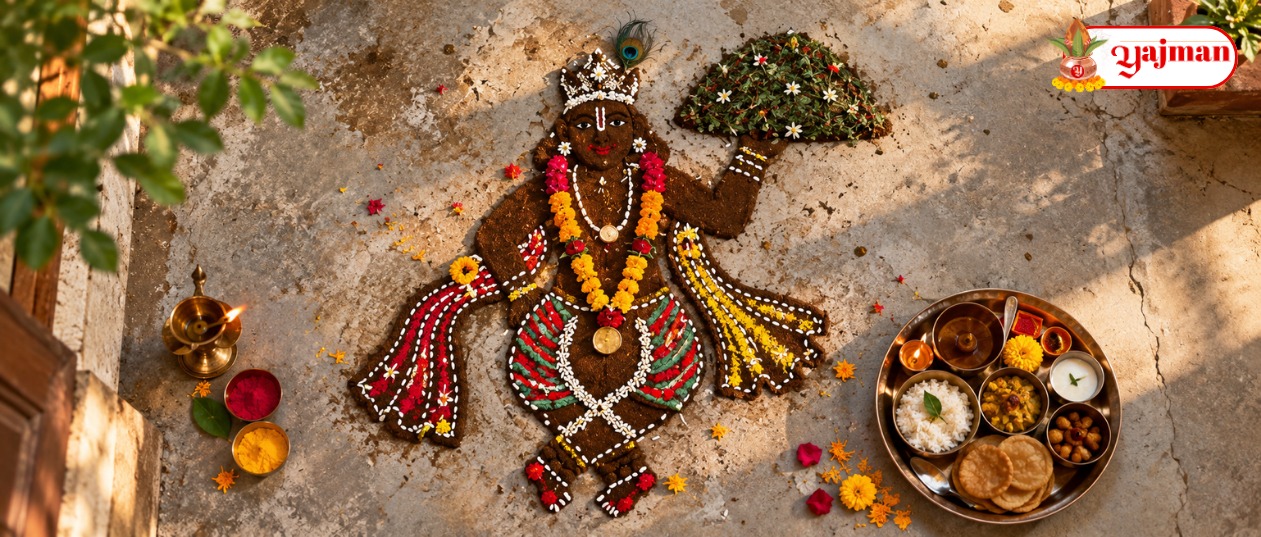
Govardhan Puja, celebrated universally on Kartik Shukla Pratipada immediately following Diwali, is a foundational Vedic festival honoring the cosmic relationship between humanity, nature, and God. At its heart, the festival commemorates the sacred day Lord Krishna lifted the colossal Govardhan Parvat on the little finger of his left hand, sheltering the inhabitants of Vraja from torrential storms, dismantling the pride of Indra, and establishing the worship of natural elements over ritual appeasement. Observed across Sanatana Dharma as Annakut, this day stands as an eternal reminder of unconditional surrender, environmental consciousness, and the supreme grace of the Divine.
The Core Significance of Govardhan Puja
Why is Govardhan Puja celebrated across millions of homes each year? In Vedic philosophy, rituals are not merely mechanical gestures; they reflect living truths. Govardhan Puja marks a pivotal spiritual shift in human civilization: the transition from transactional fear of elemental deities to pure, loving devotion and active gratitude toward mother nature.
For centuries, ancient societies worshiped the demigods out of dread—fearing lightning, famine, and floods. Through the divine pastimes at Mount Govardhan, Lord Krishna shifted humanity's focus directly to the soil beneath their feet, the sacred cows that nurture them, the pristine forests that sustain wildlife, and the majestic hills that summon rain clouds.
On this auspicious day, devotees honor:
The Living Earth: Recognizing sacred mountains, fresh water bodies, and forests as physical manifestations of the Divine.
Gau Mata: Acknowledging cows as emblems of selflessness, nourishment, and purity.
Shattered Egos: Realizing that worldly authority, power, and wealth pale in comparison to absolute humility.
The Annakut Feast: Offering an abundant mountain of satvik vegetarian preparations to Bhagavan, affirming that every grain of food belongs to the Supreme.
Whether you observe this festival through traditional cow dung deity worship, chanting ancient shlokas, preparing fifty-six bhog offerings, or performing mental circumambulation, Govardhan Puja invites peace, ecological balance, and boundless spiritual prosperity into the household.
The Scriptural Legend of Govardhana Dharana
The authentic narrative of the Govardhan Puja story is chronicled with extraordinary detail in the Shrimad Bhagavata Purana (Chapters 24 through 27), the Vishnu Purana (Book 5, Chapters 10 through 12), and the Harivamsa Purana (Vishnu Parva).
The Grand Preparations for Indra Yajna
In the sacred land of Vraja, autumn was arriving with golden breezes. The cowherd community, led by Krishna’s father Nanda Maharaja, gathered massive amounts of ghee, grains, fruits, milk and seasonal sweets to prepare for their annual ritual known as the Indra-yajna.
Seeing the grand scale of the arrangements, young Bal Krishna approached his elders with childlike innocence, asking his father about the purpose of such intense preparations.
Nanda Maharaja patiently explained that Indra was the king of the heavens and the lord of rain clouds. Because agriculture and dairy farming relied entirely on rainfall to feed their pastures, the cowherds felt an obligation to propitiate Indra through sacrifices to ensure his favor and avert misfortune.
Krishna’s Philosophical Discourse on Karma and Nature
Hearing his father's words, Krishna delivered an extraordinary philosophical discourse on Karma-mimamsa and environmental righteousness, recorded in Chapter 24 of the Tenth Canto of the Shrimad Bhagavata Purana.
Krishna explained that every living entity takes birth, experiences joy, endures suffering, and departs according to the immutable laws of Karma. Rain falls naturally due to cosmic cycles, not merely because of demigod appeasement. He reminded the elders:
"We are dwellers of the deep forests and open pastures, father. We do not dwell within walled fortress cities or palace grounds. Our life, our cattle, and our sustenance depend entirely upon this holy Govardhan Hill, our surrounding forests, and our mother cows. Therefore, let the oblations prepared for Indra be offered to this sacred mountain, our cows, and the righteous brahmanas instead."
Krishna urged the people of Vraja to redirect the prepared feast toward feeding all living beings, decorating the cows, and performing a humble circumambulation (Parikrama) of Mount Govardhan. Swayed by Krishna’s compelling wisdom and boundless charm, Nanda Maharaja and the elders agreed. They took the grains, churned butter, and fragrant sweets, offering them reverently to Govardhan Hill. At that moment, Krishna assumed a colossal divine form atop the mountain, declaring, "I am the sacred hill," and consumed the offerings with deep satisfaction, revealing that the mountain was non-different from Himself.
The Wrath of Indra and the Samvartaka Deluge
When Indra discovered that his customary sacrifice had been bypassed in favor of a hill at the counsel of a young child, his ego was bruised. Blurring his divine vision with wounded pride (Mada), he summoned the Samvartaka—the apocalyptic clouds reserved exclusively for universal dissolution.
Indra commanded the clouds to unleash devastating fury upon Gokul:
"These foolish cowherds have rejected the demigods at the word of a mortal child! Go forth and inundate Vraja with floods until neither cattle nor man remains."
Within hours, the skies over Vraja turned pitch black. Deafening thunder cracked across the horizons, followed by torrential downpours of sheet-like rain, fierce hail, and howling gales. The rivers burst their banks, drowning the pastures. Terrified, the cows bellowed in distress, sheltering their young calves with their bodies, while the shivering people of Vraja ran to Krishna, crying out for refuge.
The Miracle of Giriraj Govardhan
Seeing the terror of his loved ones, Krishna acted with serene majesty. Smiling gently, he approached the base of Mount Govardhan. Just as a playful child might casually pluck a tiny mushroom or uproot a lotus stalk from water, the young boy bent down and effortlessly lifted the colossal Govardhan Parvat into the air using only the little finger of his left hand.
He called out to all the cowherds, milkmaids, elderly sages, cows, calves, and forest animals:
"Come underneath this great hill, my dear family! Bring your cattle, your belongings and your loved ones. Do not fear the tempest; here you shall find safety."
For seven continuous days and nights, without flinching, blinking, or shifting his feet, Krishna held the mountain aloft. The roaring rains hammered against the massive rock surface, yet beneath its stony shelter, the atmosphere remained dry, serene, and warm. Looking into Krishna’s luminous eyes, the inhabitants of Vraja forgot their hunger, thirst, and physical weariness, completely absorbed in pure divine bliss.
The Humiliation and Surrender of Indra
After seven exhausting days, Indra looked down upon Vraja in complete astonishment. His destructive clouds were empty, his lightning spent, and his celestial winds pacified. Yet, not a single pebble of Govardhan had budged and not a single soul of Vraja had suffered harm.
Realizing his grave spiritual folly, Indra called back the storm clouds and dispersed the dark skies. Golden sunlight broke across the serene pastures of Vraja. With radiant smiles, Krishna asked the cowherds to safely return to their homes, after which he gently set the great mountain back in its original place on the earth.
Consumed with shame, Indra descended secretly to earth on his celestial elephant, Airavata. Carrying the divine wish-fulfilling cow, Surabhi, Indra cast aside his golden crown and fell prostrate before the feet of young Krishna in solitary penance. As narrated in Chapter 27 of the Shrimad Bhagavata Purana, Indra offered heartfelt prayers, admitting that the Supreme Lord’s actions were intended to destroy his arrogant illusion of omnipotence.
Mata Surabhi then bathed Krishna in celestial milk, while Indra performed an abhisheka using the holy waters of the heavenly Ganga. With celestial drums sounding across the heavens, Indra crowned the young Lord with the timeless name "Govinda"—the Supreme Protector and joy of the cows, the earth, and the senses.
Spiritual and Philosophical Lessons of Govardhan Puja
The Govardhan Leela is not simply a miracle story from antiquity; it contains rich philosophical paradigms applicable to daily living.
1. The Dissolution of Ahankara (Spiritual Pride)
Indra held the highest celestial office in the heavenly planets, yet his status became the breeding ground for pride and possessiveness. The Govardhan pastimes illustrate that worldly power, lineage, and spiritual titles mean nothing if one lacks humility. When ego eclipses dharma, life constructs situations that dismantle that pride. Krishna protects his devotees not merely from external storms, but from the internal tempest of arrogance.
2. Sanatana Dharma as Environmental Guardianship
Long before modern environmental movements began, Sanatana Dharma taught that nature is conscious, sacred and worthy of adoration. Mountains sustain the weather cycle, capture moisture, and host countless ecosystems; rivers supply the fluid of existence; forests give clean prana. By instructing the cowherds to worship Govardhan Parvat, Krishna demonstrated that serving the immediate ecosystem is a direct path to honoring the Supreme Divine.
3. The Divine Position of Gau Mata
The cow holds a revered role in Vedic life, symbolizing unconditional nourishment, patient forbearance, and gentleness. The products of the cow—pure milk, curd, ghee, urine and dung—are vital pillars of both spiritual rituals and organic agrarian livelihoods. During Govardhan Puja, performing Gau Puja reaffirms our solemn duty to protect and cherish cattle, preserving the balance between agriculture, humanity and planetary well-being.
The Sacred Annakut & Chhappan Bhog Tradition
A central highlight of the Govardhan festival is the preparation of Annakut, which literally translates to "a mountain of food."
The Divine Calculation of Chhappan Bhog:
Traditional Daily Meals = 8 Prahar (Meals per day)
Duration under the Mountain = 7 Days
Total Offerings = 8 x 7 = 56 Royal Offerings (Chhappan Bhog)
During the seven days that Lord Krishna held the mountain aloft, he did not consume a single grain of food or drop of water, standing unmoving for the protection of his devotees. Traditionally, the cowherds fed Krishna eight times a day (ashta-prahar). To lovingly compensate for the fifty-six missed meals, the grateful residents of Vraja prepared a royal feast comprising fifty-six unique sweet, savory, salty, sour, bitter, and astringent dishes the moment the mountain was lowered.
Spiritual Significance of Annakut Prasad
In the Vedic tradition, food prepared without selfish intent and offered to the Lord with absolute devotion transforms into Mahaprasad—food imbued with spiritual potency. During the Annakut festival:
Vast mounds of fragrant basmati rice, lentils, seasonal vegetables, flatbreads, and pooris are arranged to physically resemble Mount Govardhan.
An array of milk sweets, kheer, halwa, malpua, laddus and fruit preserves are offered in artistic arrangements.
The offering teaches unity and community: families, temples, and villages pool their harvests to cook together, ensuring that after the deities partake, every member of society—rich or poor, young or old—receives sanctified nourishment.
Step-by-Step Govardhan Puja Vidhi at Home
Observing Govardhan Puja within your household invites harmony, abundance, and auspicious protection. Here is a clear, authentic, and step-by-step Govardhan Puja vidhi practical for modern homes.
Essential Puja Samagri List
Before commencing the ritual, arrange the following sacred ingredients:
Pure cow dung (Gomaye) from a clean desi cow
Sacred Ganga jal or unboiled clean well water
Fresh cow's raw milk, fresh curd, honey, ghee, and jaggery/sugar (for Panchamrit)
Fresh flowers, bilva leaves, tulsi leaves, and durva grass
Roli, unbroken raw rice (Akshat), sandalwood paste, and turmeric powder
Earthen lamps (diyas) and cow ghee for illumination
Incense sticks (dhoop) and camphor (kapoor)
Sugarcane sticks, fresh unhusked wheat ears, batasha, and puffed grain (kheel)
Home-prepared satvik Annakut preparations, seasonal fruits, and sweets
A Kalash (brass or copper pot) filled with clean water, mango leaves, and a coconut
Step-by-Step Ritual Procedure
Step 1: Crafting the Giriraj Deity
In an open courtyard, terrace, or clean puja altar, use clean cow dung to create the reclining horizontal form of Govardhan Parvat or Bal Krishna holding the hill. The form traditionally features a crown, hands, legs, and a navel. A small hollow earthen lamp or earthen cup is placed at the center of the navel to hold offerings of milk and curd.
Step 2: Sanctification and Altar Preparation
Purify the surroundings by sprinkling Ganga jal while chanting the Gayatri or Vishnu mantra. Place the established Kalash with mango leaves and coconut beside the deity. Arrange your freshly harvested grains, batashas, puffed grains, and sugarcane around the base of the cow dung deity.
Step 3: Tilak, Adornment, and Deepa Prajvalan
Apply sacred roli, chandan, and turmeric tilak to the deity.
Sprinkle unbroken rice (akshat) across the divine form.
Adorn the deity with fresh flower garlands.
Place a tulsi leaf upon the crown and navel, as worship to Lord Krishna is complete only with the presence of sacred Tulsi.
Light a ghee lamp and fragrant dhoop to invite divine auspiciousness into the home.
Step 4: Panchamrit Abhisheka and Naivedya
Gently pour fresh raw milk, curd, honey, sugar, and ghee into the earthen cup at the navel of the deity, symbolizing the holy bathing of Govardhan. Next, present your home-cooked Annakut feast, fruits, and sweets. Sprinkle water around the food offering with a kusha grass blade or flower, chanting the sacred mantra to invite the Lord to accept the meal.
Step 5: The Sacred Govardhan Parikrama
Holding the water-filled copper pot (Kalash) with a slight trickle of water flowing from it, circumambulate the Govardhan deity clockwise four or seven times. Scatter raw rice and flower petals along your path while softly chanting the name of Giriraj Govardhan.
Step 6: Gau Puja Vidhi (Honoring the Sacred Cow)
If you have access to a cow or can visit a nearby Gaushala:
Wash the cow’s hooves with clean water.
Apply a chandan and kumkum tilak on the cow’s forehead.
Adorn the cow with a fresh flower garland.
Feed the cow fresh green grass, jaggery (gud), soaked wheat and fresh rotis.
Touch the cow’s back reverently with folded hands, seeking her blessings for household peace, good health and ethical prosperity.
Or can book your Gau Mata Pujan with Yajman app
Step 7: Final Aarti and Prasad Distribution
Conclude the ritual by performing the Govardhan Aarti with a glowing camphor lamp. Prostrate with complete surrender (Sashtanga Pranam) before the deity. Once completed, distribute the Annakut prasad immediately among all family members, friends, neighbors, and the underprivileged.
Sacred Govardhan Shlokas and Mantras
To deepen your devotion during the puja and circumambulation, recite these authentic Puranic shlokas along with their scriptural meanings:
Govardhan Prathana Shloka
When offering prayers to the deity of Mount Govardhan, chant this classical prayer:
गोवर्धन धराधार गोकुलत्राणकारक।
विष्णुबाहुकृतच्छाय गवां कोटिप्रदो भव॥
Govardhana dharadhara gokulatranakaraka |
Vishnubahukritachchhaya gavam kotiprado bhava ||
Scriptural Source: Hari-Bhakti-Vilasa
Meaning: "O Mount Govardhan, bearer of the earth, savior of Gokul, you who found pleasant shade beneath the mighty arm of Lord Vishnu (Krishna)! We bow before you; please bestow upon us the auspicious blessing of thousands of healthy cows and complete spiritual well-being."
Govardhan Parikrama Mantra
Recite this stuti while performing the sacred circumambulation:
नमस्ते गिरिराजय श्रीगोवर्धनरूपिणे।
अशेषक्लेशनाशाय परमानन्ददायिने॥
Namaste girirajaya shrigovardhanarupine |
Asheshakleshanashaya paramanandadayine ||
Scriptural Source: Skanda Purana (Mathura Khanda)
Meaning: "Salutations unto the king of mountains, Lord Giriraj in the form of Govardhan. You are the absolute destroyer of all karmic afflictions, distress, and grief, and the eternal giver of supreme, unalloyed bliss."
Surabhi Cow Prayer (Gau Mata Prathana)
While honoring cows during the puja, chant this revered prayer:
सर्वदेवमयी गावः सर्वलोकमयी तथा।
तस्माद् गां पूजयिष्यामि सर्वकामफलप्रदाम्॥
Sarvadevamayi gavah sarvalokamayi tatha |
Tasmad gam pujayishyami sarvakamaphalapradam ||
Scriptural Source: Padma Purana (Srishti Khanda)
Meaning: "Within the sacred form of the cow reside all the divine deities, and within her exist all the spiritual spheres of the universe. Therefore, I worship Mother Cow, who fulfills all righteous desires and grants complete spiritual peace."
The Govardhan Parikrama: The Holy 21-Kilometer Pilgrimage
For millions of Vaishnavas and spiritual seekers worldwide, no pilgrimage is more transformative than the sacred Govardhan Parikrama in the Braj region of Mathura and Vrindavan in Uttar Pradesh.
Spanning an approximate distance of twenty-one kilometers, this holy circumambulation follows the contours of the sacred hill where Lord Krishna walked barefoot thousands of years ago. In the Garga Samhita, it is stated that performing the Govardhan Parikrama with a pure heart expiates heavy karmic debts and grants immediate spiritual elevation.
Key Sacred Spots Along the Parikrama Route
Mansi Ganga: A holy lake situated in the center of Govardhan town. Scriptures reveal that Krishna manifested this lake from his divine mind (manas) so the cowherds could bathe in holy waters without traveling to the distant Ganga.
Daan Ghati: The historic location where Lord Krishna playfully demanded a toll tax (daan) of churned butter and milk from Radha and the Gopis before permitting them to pass through the mountain trail.
Radha Kunda and Shyama Kunda: Regarded as the two most sacred water bodies on earth by Chaitanya Mahaprabhu and the Gaudiya tradition. They represent the personified liquid love of Sri Radha and Sri Krishna.
Govinda Kunda: The serene spot where Indra, having lost his pride, performed the celestial abhisheka of young Krishna with Surabhi cow and proclaimed him Govinda.
Puchhari Ka Lautha: Located at the southern tip (the "tail") of the hill, honoring Krishna's devoted friend, Lautha Baba, who remained waiting with unwavering faith for the Lord’s return.
Devotees perform this sacred circumambulation on foot, barefoot, and sometimes even via Dandavat Parikrama—falling flat on the earth in full prostration for each step, a journey that can take weeks to complete in quiet surrender.
Bringing Authentic Vedic Traditions into Your Home
Maintaining timeless Vedic traditions can often feel overwhelming amidst the demands of modern schedules, relocations to metropolitan cities, and unfamiliarity with precise scriptural rituals. Many families wish to perform authentic festivals like Govardhan Puja, Annakut, and Gau Puja, but face common hurdles: finding verified Vedic pandits, obtaining authentic samagri, or understanding the exact shubh muhurat and vidhi.
This is where the Yajman App serves as a helpful spiritual bridge.
Built to preserve the integrity of Sanatana Dharma, Yajman App connects devotees directly with knowledgeable, certified Vedic purohits and pandits who can conduct traditional pujas right in your living room or remotely at renowned tirth kshetras. Whether you wish to organize a full-fledged Annakut Utsav, book a Gau Puja at a recognized Gaushala, or perform personal Havans, Yajman App ensures every single step honors authentic scriptural protocols.
Through Yajman App, you gain access to:
Verified Vedic Purohits: Experienced priests who perform rituals with correct mantra pronunciation and deep scriptural grounding.
Personalized Festival Guidance: Real-time astrological timings, tithi schedules, and shubh muhurats tailored to your location.
Scriptural Stories and Knowledge: An expanding digital archive of Puranic kathas, shlokas and devotional insights designed to nurture religious roots in future generations.
Embracing our ancestral roots does not require complicated compromises. With the trusted assistance of Yajman App, celebrating the divine pastimes of Giriraj Govardhan becomes an effortless, uplifting and spiritually enriching experience for the whole family.
Frequently Asked Questions (FAQ)
What is the primary message of Govardhan Puja?
The central message is the surrender of pride, the protection of nature, deep reverence for cows and trusting the unconditional shelter of the Supreme Lord over external fear.
Why is cow dung used to make the Govardhan deity?
In Vedic culture, cow dung from a desi cow is considered clean, sacred, purifying and a natural anti-bacterial agent. It represents the fertility of the earth and the presence of Goddess Lakshmi, making it the purest medium to model the form of Mount Govardhan.
What is the difference between Govardhan Puja and Annakut?
The two terms are used interchangeably for the same festival. Govardhan Puja specifically emphasizes the worship of Mount Govardhan, Lord Krishna, and the cows, while Annakut refers to the vast, mountain-like offering of vegetarian food and sweets prepared in gratitude for the Lord.
Can Govardhan Puja be performed without cow dung?
If pure cow dung is unavailable in urban apartments, devotees can model the mountain using pure garden clay, unrefined soil, mounds of unbroken rice grains, or by placing a consecrated picture or vigraha of Giriraj Govardhan on the altar, performing the offerings with sincere devotion.
Govardhan Puja remains an eternal beacon of harmony, demonstrating that when humanity honors nature and surrenders its ego before the Divine, the universe shields it from all tempests. Reclaim the joy of sacred Vedic living and bring the divine grace of Lord Giriraj into your household today.
Download Yajman App on Google Play and Apple App Store.
Stay tuned for more stories at Yajman App.